
How the Battery HV Tester Works
Once electrolyte fills a battery element, a missing or damaged separator stays hidden until the battery fails in the field. Your battery HV tester is the last instrument that can catch that fault at the dry assembly stage — the point where a rejected element returns its case and hardware intact. Post-fill, the same rejection costs 4 to 6 times more.
The ELIND DBT series applies a controlled high voltage across the dry-assembled battery element. Any defect causing leakage current above 100mA trips the automatic sensing circuit immediately — no operator judgment required. Test duration is 3 to 10 seconds per unit, viable for 100% inline testing at production line speed. Compliance reference standards include IS 8320:2000, IS 1146:1981, IEC 60664, AIS 038, and UN R100.
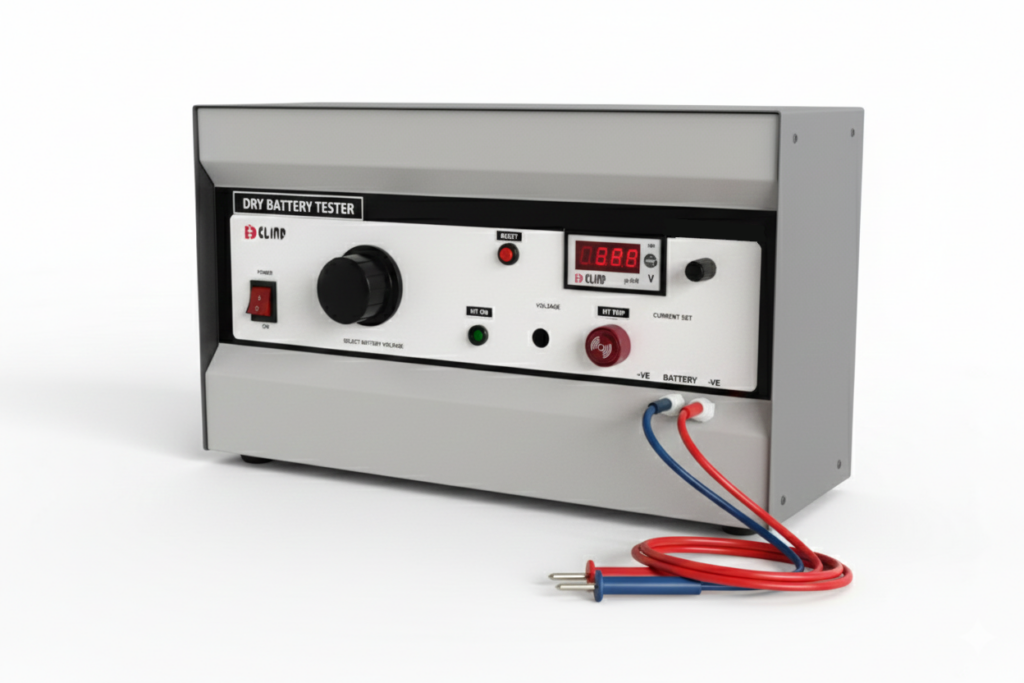
Battery HV Tester – Technical Specifications
| Input Voltage | Single Phase AC, 200–240V |
| Input Frequency | 50 Hz |
| Output Voltage | 0–500V (DBT 12-500) | 0–2000V (DBT 12-2000) |
| Output Current | 50–100 mA (max 100 mA trip threshold) |
| Voltage Resolution | 1V |
| Test Duration | 3–10 seconds |
| Pass/Fail Output | Buzzer alarm on separator short / current trip |
| Auto Cut-off | Electrical sensing circuit triggers automatic cutoff on fault |
| Enclosure | MS enclosure, powder coated |
| Dimensions (approx.) | 250mm × 450mm × 300mm |
| Weight (approx.) | 30 kg |
| Operating Temperature | 0–65°C |
| IP Rating | IP20 |
| Efficiency | >90% |
| Compliance Reference | IS 8320:2000 | IS 1146:1981 | IEC 60664 | AIS 038 | UN R100 | CEA Regulations |
Applications of Battery HV Tester
- SLI battery factories — at the scale of Exide, Amara Raja, SF Sonic, Okaya, and mid-size manufacturers — deploy the DBT series at the element assembly station to test every unit before acid fill; defective elements are rejected with case and hardware recoverable, at a fraction of the cost of post-fill rejection.
- Battery manufacturers sourcing separators from Daramic, H&V, Entek, or domestic suppliers use the DBT series for incoming lot inspection — sample HV testing each roll before production entry catches pinholes before they cause a batch failure downstream.
- RDSO-approved battery suppliers (BEML, Medha Servo) use the DBT 12-2000 for dielectric withstand testing on 110V–220V DC locomotive and EMU battery systems — the RDSO specification requires testing at 2× rated voltage + 1000V, which the 2kV model covers directly.
- Automotive battery suppliers facing OEM incoming audit requirements use the DBT series to document 100% HV dry testing per batch — building the records that reduce early field short-circuit warranty returns and satisfy OEM quality gate checklists.
Why Battery Manufacturers Choose ELIND
- ELIND has manufactured battery testing and charging equipment from the same Peenya campus, Bengaluru since 1980. Luminous Power Technologies, Tata Autocomp GY Batteries, Microtex Energy and several large and medium scale battery manufacturers are our customers across multiple product categories.
- Every DBT unit undergoes in-house testing at the Bangalore works before dispatch. You can arrange a customer inspection at the Peenya facility and verify actual trip current and voltage accuracy against the specification — not just the datasheet.
- The DBT series uses components available in the Indian market. When a part needs replacing, you source it locally — not from an overseas supplier with a four-week lead time and no service presence on the ground.
Available Models and Configurations
| Model | Max Test Voltage | Trip Threshold | Primary Application |
| DBT 12-500 | 0–500V | 100 mA | Standard SLI, VRLA separator testing |
| DBT 12-2000 | 0–2000V | 100 mA | Railway, industrial, thicker separator grades |
All units are built to order. Custom configurations available — Contact us for specifications.
Get a Quote or Technical Datasheet of the Battery Plate Formation Rectifier
To request a quotation or technical datasheet for the DBT series — send us your battery type, separator specification, and required test voltage by email, call or WhatsApp. A technical proposal with exact specifications will be returned within 48 hours.
Frequently Asked Questions
Q1: What is the difference between the DBT 12-500 and DBT 12-2000, and how do I choose?
The DBT 12-500 tests at up to 500V — suitable for standard SLI and VRLA separator types at standard thickness specifications. The DBT 12-2000 reaches 2000V, covering applications that require higher dielectric stress testing — including railway locomotive batteries where RDSO specifies 2× rated voltage + 1000V, and thicker industrial separator grades. Confirm your separator specification and applicable standard before selecting. If you are unsure which model your application requires, contact ELIND with your battery type and any relevant customer or RDSO specification.
Q2: Can this tester be used on assembled wet batteries, or only dry elements?
The DBT series is designed exclusively for dry-assembled battery elements — before electrolyte filling. Applying high voltage to a battery with electrolyte present creates a safety hazard and does not produce a valid dielectric test result. If you need end-of-line testing on fully assembled batteries after filling, the correct instrument is ELIND’s HRD Production Line Tester, which tests under high-rate discharge conditions per IS 8320 and IEC 60095-1.
Q3: What defects does the battery HV tester catch — and what does it miss?
The DBT series detects any assembly defect causing leakage current above 100mA at test voltage — specifically: missing separators, misaligned or folded separator edges, lead tree bridging between plates, and torn or pinhole-damaged separator material. It does not detect electrolyte-related faults, plate capacity issues, or intercell welding quality — those require discharge testing instruments such as ELIND’s HRD Production Line Tester or Battery Rated Capacity Tester.
Q4: Does the tester generate a per-unit test record, or is it buzzer alarm only?
The standard DBT configuration provides a buzzer alarm on fault detection and automatic cutoff — pass/fail at the instrument with no built-in data logging. If your application requires a documented per-unit test record for OEM audit compliance or ISO/IATF traceability, contact ELIND to discuss integration with ELIND’s Data Acquisition System (DAS), which logs test parameters per unit and exports timestamped CSV records compatible with Excel and standard QA systems.
Q5: Is this instrument safe for operators without specialist high-voltage training?
The DBT series includes an automatic electrical sensing circuit that cuts off output when leakage current exceeds 100mA — the instrument does not rely on operator judgment to terminate a fault condition. Standard electrical safety practices apply: operators should not contact test probes or the battery element during the 3 to 10 second test window. No high-voltage specialist certification is required for standard production operation, but the test station layout should follow IS 5216 electrical safety guidelines and your plant’s standard safety protocol for test equipment.
Q6: What is the lead time, and can I inspect the unit before accepting delivery?
Standard lead time for the DBT series is 3–4 weeks from confirmed order and advance receipt. Every unit is tested in-house at the Peenya works before dispatch — you can arrange a customer inspection at the Bangalore facility to verify actual trip current and voltage accuracy against the specification before the unit leaves the works. Installation and commissioning support is available at extra charge. Remote commissioning guidance is available at no extra charge for customers with qualified in-house electrical teams.