
How the Industrial Battery Charger Works
Your maintenance bay, QC lab, dealer shop or charging station handles multiple batteries at a time. Swapping between dedicated single-voltage chargers wastes time and budget. The ELIND BCC series is an industrial battery charger built for Indian operating conditions: transformer-based, SCR/Thyristor-controlled, and selectable across multiple voltage ranges without swapping units.
A multi-position rotary switch sets the output voltage to match your battery bank. The SCR circuit holds charge current constant throughout the cycle, even when grid voltage sags or spikes. Higher models add a digital A-V-T-AH meter and auto time-based cut-off — run an overnight charge unattended, with no overcharge risk.
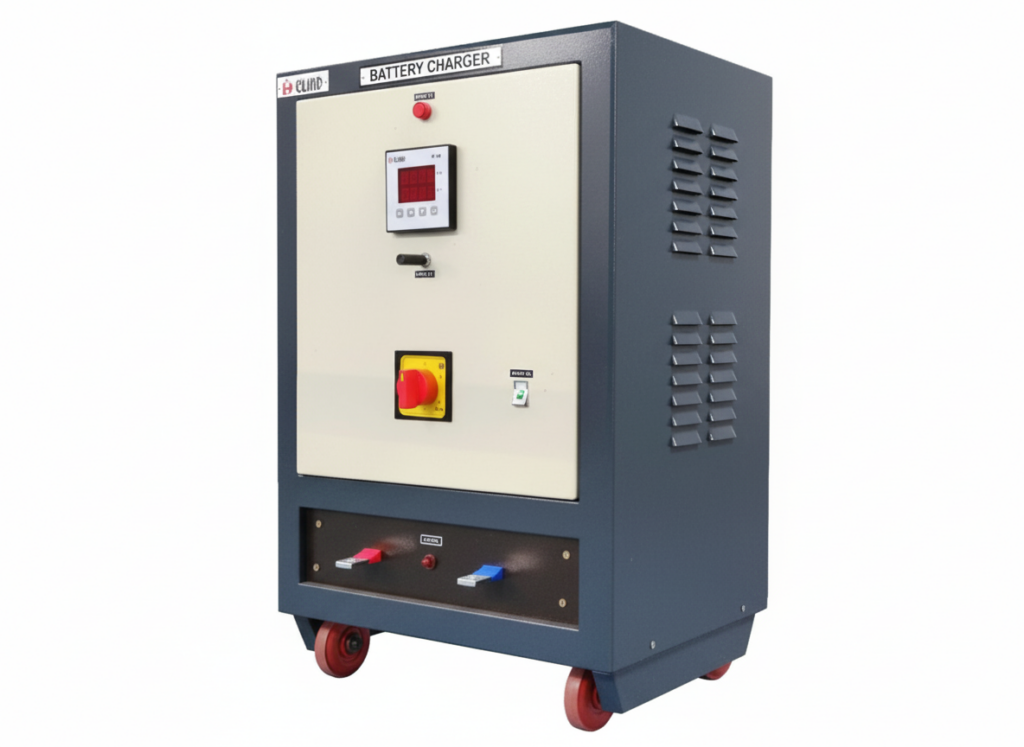
Industrial Battery Charger – Technical Specifications
| Parameter | Value |
| Input Voltage | Single Phase AC, 200–240V |
| Input Frequency | 50 Hz |
| Output Technology | Transformer-based, SCR/Thyristor controlled, Constant Current |
| Output Voltage (DC) | 32V (BCC 24-10) │ 96V (BCC 72-10) │ 160V (BCC 120 series) │ 320V (BCC 240 series) |
| Output Current | 0–10A │ 0–20A │ 0–30A (model dependent) |
| Current Regulation | ±5% of set value |
| AH Measurement Accuracy | <5% (higher models with A-V-T-AH meter) |
| Output Ripple | ~30% (single-phase transformer; reduced with filter choke at output) |
| Battery Chemistry | Lead Acid │ VRLA │ SMF |
| Battery Voltage Range | 24V / 48V / 72V / 120V / 240V via multi-position rotary switch (range is model-dependent) |
| Cutoff Modes | Time-based │ AH-based (higher models only) |
| Reverse Polarity | Visual alarm indicator on all models |
| Mounting | Bench-top: BCC 24-10, 72-10, 120-10 │ Wheel-mounted: BCC 120-10-SP, 120-20, 240-10, 240-20, 240-30 |
| Dimensions — Bench-top | ~250mm × 450mm × 300mm |
| Dimensions — Wheel-mounted | ~600mm × 450mm × 450mm |
| Weight — Bench-top | 30–40 kg |
| Weight — Wheel-mounted | 80–100 kg |
| Operating Temperature | 0–65°C |
| IP Rating | IP20 |
| Efficiency | >90% |
| Compliance Reference | IS 8320 (referenced) |
Pre-Dispatch Testing
Every Industrial Battery Charger ELIND ships undergoes the following in-house checks before dispatch:
- No-load output voltage verification
- On-load voltage check across the full DC output range
- Constant current regulation verified across the full settable range
- Output shunt millivolt measurement for current calibration confirmation
No unit leaves the Peenya campus without passing all the above checks.
Applications of Battery VRLA Charger
- Battery testing laboratories use the BCC series to prepare batteries at precise C/10 or C/20 charge rates before IS/IEC compliance discharge tests — auto cutoff enables unattended overnight charging at NABL labs, ETDC, ERDA, CPRI, and OEM QC lines.
- Defence and government vehicle workshops replace three or four dedicated single-voltage chargers with one BCC unit — the multi-position rotary switch covers a mixed fleet’s full voltage range, the transformer-based design tolerates DG set power quality, and IS 8320 reference compliance supports GeM procurement eligibility.
- Forklift and material handling operators use wheel-mounted BCC 240-series units to maintain 24V, 48V, and 72V traction battery banks across multiple bays — AH-based cutoff delivers a consistent end-of-shift charge rate without operator supervision.
- E-rickshaw charging stations and EV service centres charge 48V and 60V VRLA packs at unattended bays — auto time cut-off prevents overcharge on high-turnover days, and the reverse polarity indicator protects cells when non-technical operators connect the leads.
- Service centres and battery dealers use the industrial battery chargers for replenishing the charge on a certain number of batteries per day. Since this number is not fixed, the battery voltage selection switch makes this charger a versatile tool.
Why Battery Manufacturers Choose ELIND
- ELIND has manufactured battery charging and testing equipment from the same Peenya campus, Bengaluru, since 1980. Luminous Power Technologies, Tata Autocomp GY Batteries, Microtex Energy, Okay Power etc are some of our customers across multiple product categories. The equipment runs for 15–20 years without significant intervention — that is not a claim, it is what our customer logs show.
- Every BCC unit undergoes in-house testing at the Bangalore works before dispatch. You can arrange a customer inspection at the Peenya facility — verify actual output current and regulation accuracy against the spec, not just the datasheet.
- Transformer-based SCR construction uses components available in the Indian market. When a part needs replacing, you source it locally — not from an overseas supplier with a four-week lead time and no service capability on the ground.
Industrial Battery Charger – Available Models and Configurations
| Model | Max DC Output | Max Current | Mounting | Display & Cutoff |
| BCC 24-10 | 32V DC | 0–10A | Bench-top | Digital V+A only; no cutoff |
| BCC 72-10 | 96V DC | 0–10A | Bench-top | Digital V+A only; no cutoff |
| BCC 120-10 | 160V DC | 0–10A | Bench-top | Digital V+A only; no cutoff |
| BCC 120-10-SP | 160V DC | 0–10A | Wheel-mounted | A-V-T-AH meter + auto time cutoff |
| BCC 120-20 | 160V DC | 0–20A | Wheel-mounted | A-V-T-AH meter + auto time cutoff |
| BCC 240-10 | 320V DC | 0–10A | Wheel-mounted | A-V-T-AH meter + auto time cutoff |
| BCC 240-20 | 320V DC | 0–20A | Wheel-mounted | A-V-T-AH meter + auto time cutoff |
| BCC 240-30 | 320V DC | 0–30A | Wheel-mounted | A-V-T-AH meter + auto time cutoff |
Most BCC models are available ex-stock from the Bangalore works — confirm availability before placing an order. Custom voltage, current, and configuration requirements are available. [Contact ELIND for specifications]
Get a Quote or Technical Datasheet of the Industrial Battery Charger
To request a quotation or technical datasheet for the BCC series of industrial battery chargers, send us an email or call us / drop us a message on WhatsApp with your battery voltage range, required charge current, and application context.
Frequently Asked Questions
Q1: Which BCC model should I select for my application?
Select on two parameters: the total voltage of your battery bank when batteries are charged in series, and the charge current you need. The BCC 120-series covers banks up to 160V DC (up to 10 batteries of 12V in series). The BCC 240-series covers banks up to 320V DC (up to 20 batteries). Contact us with your battery voltage, Ah rating, and required charge time to confirm the right model.
Q2: Can I charge a single 12V battery with this unit, or does it require a series bank?
You can charge a single 12V battery. The multi-position rotary switch sets the output voltage to the nominal level of whatever bank you connect — one battery or twenty in series. The BCC 24-10 is the right starting point for single 12V or 24V battery applications at up to 10A. For mixed-size banks where you sometimes charge one battery and sometimes ten, the BCC 120 or BCC 240 series gives you the range to cover both without switching units.
Q3: How does the AH meter help me in a QC lab or charging station context?
The A-V-T-AH meter on higher BCC models (BCC 120-10-SP and above) logs total Ampere-Hours delivered into the battery during the charge cycle. In a QC lab, this tells you whether the battery accepted a full charge — a battery that accepts significantly less AH than its rated capacity at the correct charge current is already degraded. In a charging station context, it gives operators a consistent measure of charge delivered per cycle, independent of how long the charger ran. The auto time-based cutoff stops the charge at a set duration; the AH reading records how much energy actually went in.
Q4: What is the difference between the BCC series and ELIND’s VRLA Battery Charger — when do I need the other one?
The industrial battery charger BCC series charges at constant current (CC) only (CC-CV charging profiles can also be configured in these models as per your specific requirements). VRLA and AGM batteries tolerate constant current up to approximately 80–90% state of charge, after which they need the current to taper as voltage is held constant — this is the CC-CV (Constant Current–Constant Voltage) profile. If you are running an overnight charge on a sealed VRLA bank and relying on the time cut-off to prevent overcharge, the BCC series works for that use case with appropriate timer settings. If your application requires a proper CC-CV profile with a programmable transition point — multi-channel UPS activation, solar storage, or float maintenance — ELIND’s dedicated Battery VRLA Charger series is the correct instrument.
Q5: Can this charger run on DG set power, or does it need stable grid supply?
The industrial battery charger BCC series is designed specifically for Indian site conditions, which include DG set power with its characteristic voltage swings and frequency variation. The transformer-based SCR circuit absorbs input voltage transients without tripping or resetting — unlike SMPS-based chargers that fault out when a DG set kicks in or shuts down. Output current regulation holds within ±5% across the input voltage range of 200–240V. This makes the BCC series a practical choice for government vehicle workshops, remote industrial sites, and any facility that runs on DG backup for part of the day.
Q6: Are the battery charger models portable between charging bays?
Yes. The BCC 120-10-SP, BCC 120-20, BCC 240-10, BCC 240-20, and BCC 240-30 are all wheel-mounted for floor mobility. Two operators can reposition a unit between bays or across production areas without mechanical handling equipment. Even the table-mounted models are easy to handle and operate and cam be shifted between charging bays easily.