
How the Battery HRD Production Line Tester Works
End-of-line testing is the last quality gate before a battery reaches your customer. A unit that passes through formation, charging, and assembly with an invisible intercell welding fault will fail in the field, weeks after it has left your plant. By then, the defect has become a warranty claim, a distributor complaint, and a potential OEM supplier review.
ELIND’s Battery HRD Production Line Tester runs a 3–10 second constant current discharge on every 12V battery before it reaches the packaging station. At discharge currents from 30A to 3000A, the on-load voltage reading identifies intercell weld failures, under-charged batteries, and OCV anomalies that no visual inspection or static check can detect. A faulty battery stops. The result is logged. The good battery moves forward.
In the PLC-controlled, conveyor-integrated configuration, this sequence runs without operator intervention. The conveyor stops at the test station. The pneumatic jig clamps the battery terminals. The discharge fires. The PLC logs pass or fail, along with the battery barcode if scanning is enabled. The conveyor resumes. At 3–10 seconds per battery, a high-volume SLI line loses nothing in throughput.
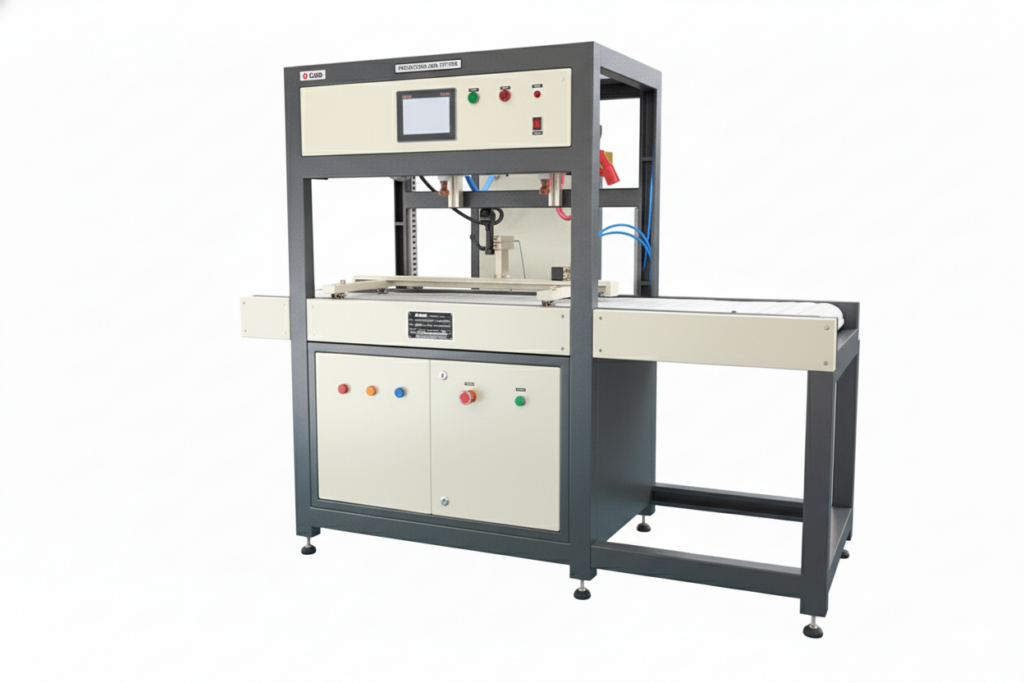
Battery HRD Production Line Tester — Technical Specifications
| Parameter | Value |
| Input Voltage | Single Phase AC, 200–240V |
| Input Frequency | 50 Hz |
| Battery Type | 12 Volt Lead Acid (SLI, VRLA, Tubular) |
| Discharge Mode | Constant Current High Rate Discharge |
| Discharge Current Range | 30–300A | 60–600A | 100–1000A | 150–1500A | 300–3000A (model dependent) |
| Current Accuracy | ±1% from 10% to 100% of full-scale range |
| Voltage Accuracy | ±1% |
| Test Duration | 3–10 seconds (production line speed optimised) |
| End Voltage Setting | 6V to 15V (user-settable) |
| OCV Window Setting | 6V to 16V — upper and lower limits user-settable |
| Communication Output | Serial (serial-to-USB) or Modbus — PLC units | USB pen drive via DBLogTool — HMI units |
| Data Output Format | CSV: Battery Barcode | OCV | End Voltage | Discharge Current | Test Time | Pass/Fail |
| Conveyor Interface | Motorised belt or modular conveyor — PLC command controlled (online models) |
| PC Interface | USB 2.0 / USB 3.0 |
| Enclosure — Manual | MS cabinet, powder coated | Approx. 1000mm × 600mm × 600mm | ~120–150 kg |
| Enclosure — Online/PLC | MS cabinet + SS conveyor with Zn-plated rollers | Approx. 1800mm × 1800mm × 1000mm |
| Operating Temperature | 0–65°C |
| IP Rating | IP20 |
| Efficiency | >90% |
| Compliance Standards | IEC 60095-1 | IS 8320:2000 |
† Conveyor length, PLC integration, barcode scanner specification, and communication protocol are confirmed at enquiry stage — contact us for a configured proposal.
Manufacturing Defects The Battery HRD Production Line Tester Catches
The HRD production line tester is designed to catch three categories of defect that escape all upstream process checks:
- Intercell welding joint (weak or open). The most critical defect in SLI battery manufacturing. A weld that looks intact may carry no useful current under high-rate discharge. The on-load voltage drop identifies this in under 10 seconds; before the battery reaches packaging.
- OCV below lower window limit. The battery is not sufficiently charged. Connecting an under-charged battery directly to a high-rate discharge load risks damaging the load bank. The OCV pre-check prevents this automatically.
- OCV above upper window limit. The battery is overcharged. Both conditions are caught by the user-settable OCV window (6V to 16V upper and lower) before the discharge current fires.
These three defect types account for the majority of end-of-line battery returns from distributors and OEM customers. Catching them at the production line (before packaging) eliminates the cost of field failures, warranty processing, and OEM supplier audits triggered by customer complaints.
Pre-Dispatch Testing
Every Battery HRD Production Line Tester undergoes ELIND’s internal test standard before it leaves the Peenya campus. This covers:
- No-load and on-load voltage verification
- On-load discharge current regulation verified across the full settable range
- OCV window check — upper and lower limit operation confirmed against reference batteries
- Pass/Fail output indication tested against known-good and known-defective reference conditions
- PLC/HMI communication and CSV data output verified — for PLC-configured units
No unit is dispatched without passing all five checks.
Applications of the Battery HRD Production Line Tester
100% end-of-line quality gate — large-scale SLI battery factory (Online/PLC model). At 2,000–5,000 batteries per shift, a manual sampling approach will miss defective units. The PLC conveyor-integrated configuration tests every battery at 3–5 seconds per unit — with automatic logging and pass/fail indication. No defective battery reaches packaging without slowing production throughput. This is the configuration specified by high-volume SLI manufacturers who ship to OEM customers with zero-defect incoming quality requirements.
100% end-of-line quality gate — SME battery factory (Manual model). At 100–500 batteries per shift, the standalone manual HRD-PLT gives SME manufacturers the same quality gate that large-scale manufacturers run — at an accessible price point. An operator connects each battery, initiates the test, and reads the result from the HMI. No ongoing software licence. No proprietary support dependency. The data is logged and exportable.
Multi-model production line with OEM traceability requirements (Online/PLC model). Mixed SLI and inverter battery lines require the tester parameters to change per battery model. The HMI supports per-model parameter entry — discharge current, end voltage, OCV window — with results linked to each battery barcode in the CSV output. This supports IATF 16949 batch traceability requirements without manual data transfer between the test station and the quality management system.
Incoming quality screening at battery reconditioning facilities (Manual model). Before investing reconditioning labour and materials on a battery, a 10-second HRD test at intake separates batteries worth reconditioning from those with intercell weld failures that cannot be economically repaired. The OCV pre-check also prevents connecting dangerously discharged units to the discharge load — a safety measure as much as a quality gate.
Why Battery Manufacturers Choose ELIND
3–10 second test time — built for 100% inline testing at production speed. Most battery plants cannot afford a test that slows throughput. ELIND’s HRD Production Line Tester is engineered specifically for that constraint. The 3–10 second test window means a 500-battery-per-hour line spends under 90 minutes of gross shift capacity on testing — and that testing eliminates the cost of every defective battery that would otherwise leave the plant, enter the distribution chain, and surface as a warranty return.
Modbus output for MES integration — in production at Tata Autocomp GY Batteries. ELIND’s PLC-based tester supports Modbus communication, allowing test results to be pulled directly into plant-level MES or ERP systems. Tata Autocomp GY Batteries has used this configuration for production data integration. For manufacturers operating IATF 16949 production control systems, this eliminates having to keep manual records of the test data to be communicated to the quality control team. Specify your protocol at enquiry stage.
PLC and HMI your maintenance team can operate — no proprietary software lock-in. The controller does not depend on a vendor call-out to change parameters, retrieve data, or diagnose a fault. Your operators set discharge current, OCV window limits, and end voltage directly on the HMI. There is no software licence to renew and no overseas vendor to wait on when something needs attention.
Battery HRD Production Line Tester – Available Models and Configurations
ELIND’s Battery HRD Production Line Tester is available in manual (standalone) and online (PLC conveyor-integrated) configurations across five discharge current ratings. All units are built to order.
Manual Models — HRD-PLT 12-[Current]
| Model | Discharge Current Range |
| HRD-PLT 12-300 | 30A – 300A |
| HRD-PLT 12-600 | 60A – 600A |
| HRD-PLT 12-1000 | 100A – 1000A |
| HRD-PLT 12-1500 | 150A – 1500A |
| HRD-PLT 12-3000 | 300A – 3000A |
Online / PLC Conveyor-Integrated Models — HRD-PLT 12-[Current]-PLC
| Model | Discharge Current Range |
| HRD-PLT 12-300-PLC | 30A – 300A |
| HRD-PLT 12-600-PLC | 60A – 600A |
| HRD-PLT 12-1000-PLC | 100A – 1000A |
| HRD-PLT 12-1500-PLC | 150A – 1500A |
| HRD-PLT 12-3000-PLC | 300A – 3000A |
Configuration Options — Confirmed at Enquiry Stage
| Parameter | Options |
| Hardware Configuration | Manual standalone | PLC conveyor-integrated (online) |
| Discharge Current | 300A | 600A | 1000A | 1500A | 3000A | Higher on request |
| Barcode Scanning | Optional — links test record to battery serial number / barcode |
| Communication Output | Serial-to-USB | Modbus (for MES/ERP integration) |
| Conveyor Type | Motorised belt | Modular conveyor | Configured to existing line layout |
| PC Software (Optional) | Real-time dashboard, automatic CSV storage, Windows 7/10/11 compatible |
Model designation: HRD-PLT 12-600 = Battery HRD Production Line Tester, 12V battery, 600A maximum discharge, manual configuration. HRD-PLT 12-600-PLC = same current rating, PLC conveyor-integrated.
Standard lead time: 3–4 weeks from confirmed order and advance receipt. Minimum order quantity: 1 unit.
Get a Quote or Technical Datasheet for the Battery HRD Production Line Tester
Share your battery type, required discharge current, production volume per shift, and whether you need a standalone manual unit or PLC conveyor-integrated configuration. Send us an email or call us / drop us a message on WhatsApp for more details. A configured technical proposal will be returned within 48 hours.
Frequently Asked Questions
Q1: How do I choose between the manual and PLC conveyor-integrated model?
The decision comes down to production volume and line structure. For 100–500 batteries per shift on a manual line, the standalone HRD-PLT is the practical choice. An operator connects each battery, initiates the test, and reads the test result. For lines running 500+ batteries per shift where the battery already moves on a conveyor, the PLC-integrated model is the correct specification. It removes the operator from the test cycle entirely and logs every result without manual data entry. If you are evaluating both, share your shift volume and line layout with ELIND. The configuration is determined at order stage and cannot be retrofitted easily after delivery.
Q2: What discharge current should I specify for my battery type?
The correct discharge current depends on your battery’s Cold Cranking Ampere (CCA) rating and the end-of-line test standard you are applying. For most automotive SLI batteries, the HRD test current matches the battery’s EN or SAE CCA rating — typically 150A to 600A for standard passenger vehicle batteries. Commercial vehicle batteries and inverter batteries may require 1000A or above. Share your battery model’s CCA specification with ELIND’s technical team and they will confirm the appropriate HRD-PLT model.
Q3: Can OCV window limits be changed when switching between battery models on the same line?
Yes. The OCV window (upper and lower limits) along with discharge current and end voltage are user-settable on the controller for each battery type. The parameters are entered by the operator at the start of each batch. On HMI-equipped models, a model name and battery type field can also be entered — this appears in the CSV output alongside each test record, making it straightforward to trace results back to a specific battery model without relying on the operator to annotate data manually after the fact.
Q4: Does the tester log test data, and in what format?
Yes. Every test result is automatically recorded in CSV format. Battery barcode (if scanning is enabled on the HMI-equipped models), OCV, on-load end voltage, discharge current, test time, and pass/fail result. The data is exported into USB format and opens directly in Excel for review, batch analysis, or quality records. For manufacturers who need test records linked to specific battery models, the HMI-equipped models allow a model name and battery type to be entered, which appears as a field in the CSV output alongside each test result.
Q5: How long does installation and commissioning take?
Both models are designed to be straightforward to install and commission using the operating manuals provided with each unit. For most customers, commissioning support is handled over a video call — ELIND’s team walks through parameter setup, operator controls, and a reference battery test run remotely. On-site commissioning visits are available on a chargeable basis and are arranged case by case at order stage.
Q6: What is ELIND’s service arrangement for a plant outside Bengaluru?
ELIND’s service team operates from the Peenya campus in Bengaluru. For diagnosis and troubleshooting, remote support is available — ELIND designed and built the equipment in-house, so faults can typically be identified and guided through remotely without an on-site visit. Where a physical visit is needed, ELIND arranges this on a case-by-case basis at an additional charge.