
How the Battery Plate Formation Rectifier Works
Battery plate formation is a chemistry problem before it is an equipment problem. Raw lead oxide paste becomes active plate material — PbO₂ on the positive, sponge lead on the negative — only when current stays precise and stable across every hour of a 24–120 hour cycle. Drop the regulation, and the plate does not form correctly. It ships, fails under load, and comes back as a warranty claim.
ELIND’s battery plate formation rectifier uses SCR/Thyristor control to regulate constant current within ±1% of the set value — even as bath impedance shifts with temperature during cycling. A 10-step programmable profile manages charge, discharge, and pause phases automatically, without operator intervention. Output voltage is configured to your jar count: 3V per jar in series, from 80V to 360V DC.
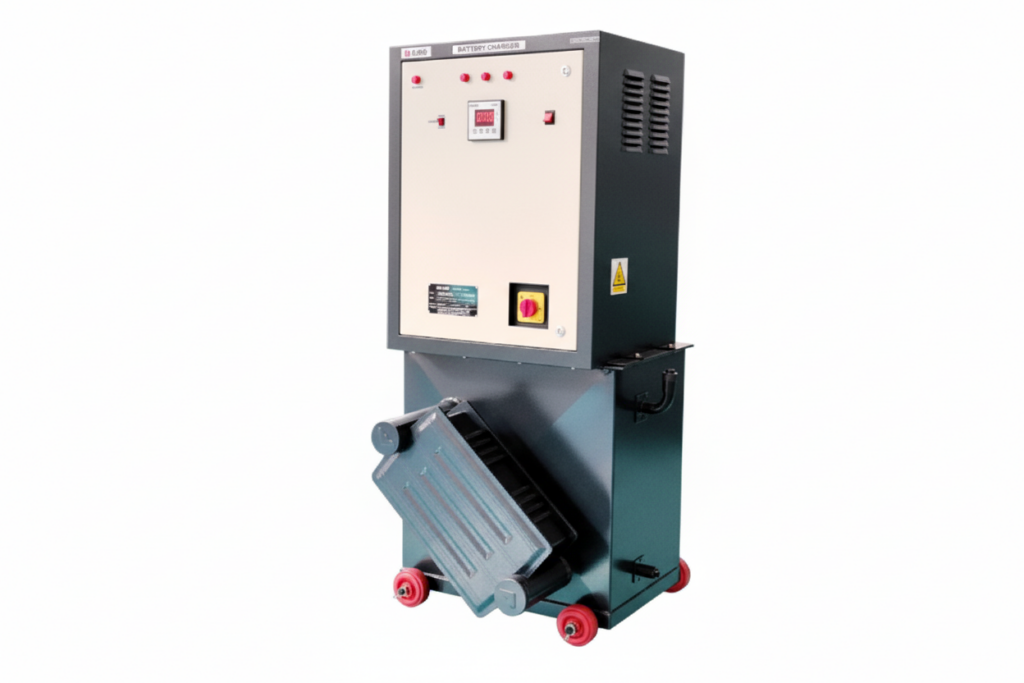
Battery Plate Formation Rectifier – Technical Specifications
| Parameter | Value |
| Input Voltage | Three Phase AC, 380–440V |
| Input Frequency | 50 Hz |
| Output Voltage Range | 80V–360V DC † |
| Output Current | 20A | 30A | 50A | 100A † |
| Control Technology | SCR (Thyristor), Constant Current |
| Voltage Regulation | ±1% of set value |
| Current Regulation | ±1% of full-scale range |
| Output Ripple | <5% at full load |
| Formation Profile Steps | 10 programmable steps (Charge / Discharge / Pause) |
| Number of Channels | 1 | 2 | 3 | 4 | 6 † |
| Typical Formation Cycle | 24–48 hours (SLI) | Up to 120 hours (tubular traction) |
| Transformer Type | Oil-cooled or air-cooled † |
| Data Logging (PLC-equipped units) | Optional Add-on (Parameters logged are Battery Voltage, Current, Current Step, Cycle Count, Process Time) † |
| Cabinet Dimensions (approx.) | 1600mm × 600mm × 650mm (varies per configuration) |
| Weight (approx.) | ~500 kg (single channel, mid-range) |
| Operating Temperature | 0–65°C |
| IP Rating | IP20 |
| Efficiency | >90% |
† Configured to your specification — contact ELIND for a quote.
Pre-Dispatch Testing
Every battery plate formation rectifier unit undergoes ELIND’s internal test standard before it leaves the Peenya campus. This covers:
- No-load output voltage verification
- On-load voltage check across the full DC output range
- Constant current regulation verified across the full settable range
- AC input current measurement at full load
- Output shunt millivolt measurement for current calibration confirmation
No unit is dispatched without passing all five checks.
Applications of Battery Plate Formation Rectifier
- SLI automotive battery plate formation at scale. Multi-step current profiles over 48–72 hours with oil-cooled transformer for continuous heavy-duty operation. Suitable for formation lines running at the volume of Exide, Amara Raja, and SF Sonic.
- Tubular positive plate formation for industrial and traction batteries. Programmable step transitions by timer or Ah-counter across cycles up to 120 hours. Prevents overformation that degrades gauntlet material — a failure mode that does not surface until batteries reach the customer.
- VRLA (AGM/Gel) plate formation for telecom and UPS manufacturers. Low-rate charging at C/20–C/40 with a strict per-cell voltage ceiling. Multi-channel configurations with SCR-controlled current balance per channel.
- R&D plate formation at battery research institutions. Fully programmable arbitrary multi-step current-time-voltage profiles with PC interface and data logging per stage. Used at IIT, ARCI, ISRO, and DRDO battery R&D labs for new chemistry development.
Why Battery Manufacturers Choose ELIND
- Formation rectifiers in Indian battery plants since 1980. ELIND has supplied formation equipment to Microtex Energy, Sakthi Accumulators, Jayachandran Industries, DB Dixon Batteries, PMK Energy, Accumulator Industries, Al Nader Battery Factory (Saudi Arabia) and many more manufacturers across India and in overseas markets. That track record is verifiable — reference calls with existing customers are available for serious evaluations.
- Oil-cooled / air-cooled transformers built for Indian ambient temperatures. Formation is a continuous-duty process that runs through the summer. ELIND’s oil-cooled / air-cooled transformers are engineered for ambient temperatures up to 45°C — the actual condition on a formation floor in Rajasthan, Tamil Nadu, or Gujarat.
- Electronic control your maintenance team can operate independently. The formation controller does not depend on proprietary software licences or vendor call-outs. Your operators set profiles, monitor cycles, and troubleshoot faults on the electronic controller — without calling anyone.
Available Models and Configurations
ELIND’s battery plate formation rectifier is built entirely to your specification. There is no catalogue to choose from — the output voltage, current, and channel count are determined by your formation setup.
| Parameter | Options |
| Output Voltage | 3V per jar × number of jars in series (typically 80V–360V DC) |
| Output Current | 20A | 30A | 50A | 100A | Higher on request |
| Number of Channels | 1 | 2 | 3 | 4 | 6 | Custom |
| Transformer Cooling | Oil-cooled (continuous duty) | Air-cooled |
| Data Logging | Optional add-on |
| Controller Type | PLC/HMI | Microcontroller-based |
Model designation: EPFR [Max Voltage]-[Max Current]. Example: EPFR 300-50 forms up to 100 jars in series at 50A.
Standard lead time: 3–4 weeks from confirmed order and advance receipt. Minimum order quantity: 1 unit.
All units are built to order. Custom configurations available — [Contact ELIND for specifications].
Get a Quote or Technical Datasheet of the Battery Plate Formation Rectifier
Send us your formation setup details — jar count, battery type (SLI / tubular / VRLA), required current, and number of channels — by email, call or WhatsApp. A technical proposal with exact specifications will be returned within 48 hours.
Frequently Asked Questions
Q1: How do I specify the correct output voltage for my formation setup?
Output voltage is calculated at 3V per jar in series — so if your formation tank runs 100 jars, you need a rectifier rated for 300V DC output. Share your jar count, battery type (SLI, tubular, or VRLA), and required current, and ELIND will configure the EPFR model designation to match exactly. Standard output voltage range is 80V–360V DC, with higher configurations available on request.
Q2: What is the difference between the oil-cooled and air-cooled transformer options, and which is right for our plant?
Oil-cooled transformers are built for continuous 24/7 formation duty in ambient temperatures up to 45°C — the realistic condition on most Indian formation floors through summer. Air-cooled configurations are suited to lower-throughput or intermittent-duty applications where heat dissipation load is manageable. If your formation line runs back-to-back cycles without extended cooldown breaks, specify the oil-cooled option — that is what ELIND supplies to high-volume SLI manufacturers running multi-channel systems.
Q3: Can the formation profile be changed when we switch between battery types — for example, from SLI plates to tubular plates on the same machine?
Yes. The EPFR controller supports up to 10 programmable steps, with each step configurable for current or pause mode, along with the time duration. Step transitions trigger by timer or Ah-counter, depending on how your formation process is managed.
Q4: Our plant is in an industrial estate where grid voltage fluctuates significantly — sometimes dropping to 380V or spiking above 430V on a three-phase supply. Will the formation rectifier hold regulation under these conditions?
Yes — this is one of the practical reasons ELIND uses transformer-based SCR control rather than switch-mode or IGBT-based designs for formation rectifiers. SCR/thyristor-controlled transformer systems tolerate wide input voltage variation without tripping or losing output regulation. The SCR firing angle adjusts continuously to compensate for input fluctuations, maintaining constant current output to your formation jars even when the grid is unstable. Switch-mode and IGBT-based systems are more sensitive to input voltage variation — they are engineered for clean, stable grid conditions that most Indian industrial estates, particularly in tier-2 and tier-3 locations, do not consistently deliver.
For plants with unusually severe grid conditions, share your voltage variation range with ELIND’s technical team at the enquiry stage — the transformer can be wound to suit your specific input range.
Q5: Does the rectifier support data logging, and what format does it output in?
Data logging is available as an optional add-on, configured to your requirement at the time of order. On ELIND’s PLC-based systems, logged parameters include process current, voltage, time, and Ah — output in CSV format compatible with Excel and standard analysis tools. This satisfies traceability requirements for OEM suppliers and ISO-audited manufacturers who need per-batch formation records. Specify data logging at the enquiry stage; it affects the controller configuration and cannot be retrofitted easily.
Q6: If the rectifier develops a fault mid-formation cycle, what is the support arrangement — and how quickly can ELIND respond?
ELIND’s service support operates from the Peenya campus in Bengaluru. For diagnosis, spare parts, and remote guidance, response is fast — ELIND designed and built the equipment in-house, so there is no third-party dependency in identifying or sourcing a fix. Physical on-site service visits outside Bengaluru are available at an additional charge and are arranged case by case. The practical mitigation for remote plants is that transformer-based SCR equipment has fewer failure-prone components than IGBT or switch-mode systems — and ELIND’s pre-dispatch testing (five checks including full-load regulation verification) is designed to surface faults before the unit reaches your plant, not after.