
How the DC Rectifier for Electroplating Works
Uneven coating, burn marks, and alloy drift in your plating bath trace back to one cause: unstable rectifier output. Your process specifies a current density — in amps per square decimetre — that must hold constant as bath impedance changes with temperature, agitation, and metal ion concentration. The ELIND EPR series is a DC rectifier for electroplating built to your exact process voltage and current requirements. SCR/Thyristor-controlled, transformer-based, with ±1% voltage and current regulation at full load. Hard chrome, zinc-nickel, CED primer coating, aerospace anodising, electropolishing — each application gets a rectifier configured to its specific demands.
Add-on features are specified at order: voltage ramping for processes where current-on causes burn or film rupture, step programming for multi-stage cycles, and data recording for IATF 16949, NADCAP, and FDA audit trails. You specify what your process needs. You do not pay for what it does not.
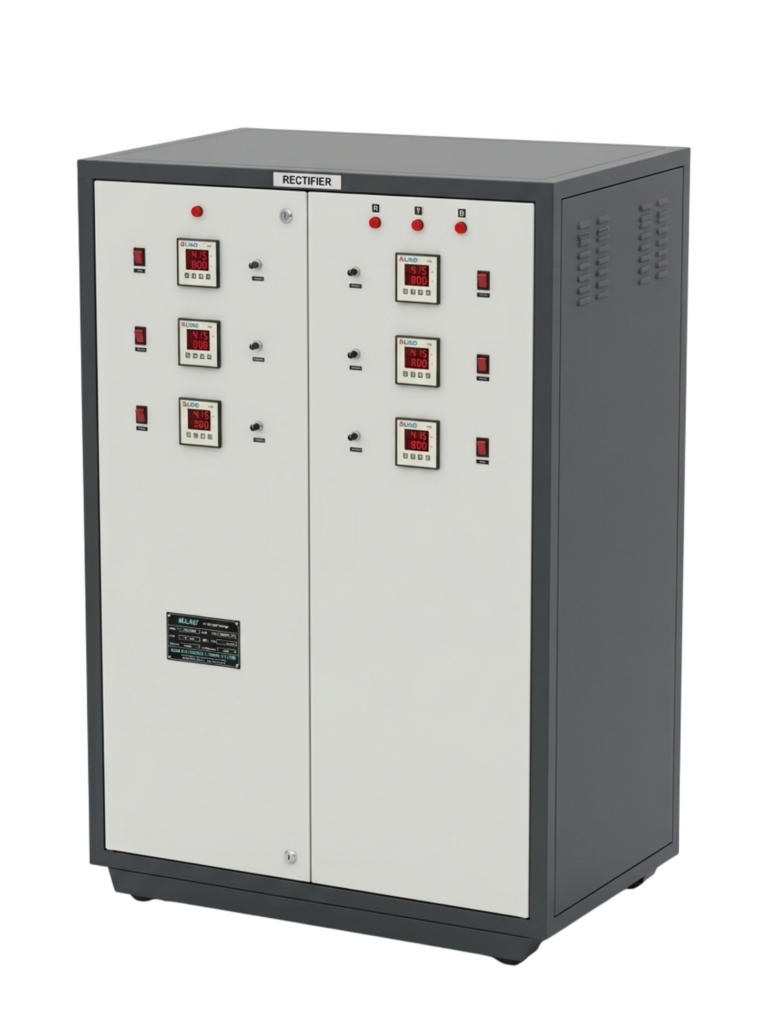
DC Rectifier for Electroplating – Technical Specifications
| Parameter | Value |
| Input Voltage | Three Phase AC, 380–440V |
| Input Frequency | 50 Hz |
| Output Voltage | Configured to your process requirement † |
| Output Current | Configured to your process requirement † |
| Control Technology | SCR/Thyristor controlled; dimmer-controlled option available for wide output-voltage range † |
| Voltage Regulation | ±1% |
| Current Regulation | ±1% of full-scale range |
| Output Ripple | <5% at full load |
| Efficiency | >90% |
| Transformer Type | Oil-cooled or air-cooled † |
| Multi-Channel Output | Available for parallel plating operations † |
| Voltage Ramping | Programmable start → end voltage per step; user-set ramp rate; up to 10 steps † |
| Step Programming | Up to 10 programmable steps (start volt, end volt, time per step) † |
| Data Recording | Voltage | Current | Time | Step | Cycle — at user-set intervals; timestamped CSV/Excel export † |
| Metering | Digital A-V-T-AH meter; AH cutoff and time cutoff option |
| Enclosure | MS cabinet, powder coated |
| Typical Dimensions | Approx. 1200mm × 750mm × 650mm (mid-range unit; varies by output rating) |
| Typical Weight | 300–500 kg (mid-range; varies by output rating) |
| Operating Temperature | 0–65°C |
| IP Rating | IP20 |
| Standard Lead Time | 3–4 weeks from confirmed order and advance receipt |
† Configured to your specification — contact us for a quote.
Compliance: The EPR series is designed to enable customer compliance with MIL-STD-1501, AMS 2460, IS 1573, ASTM B633 (chrome/nickel plating); MIL-A-8625 Type III, NADCAP, DEF STAN 03-26 (aerospace anodising); AMS 2400, AMS 2417, AS9100 (cadmium/Zn-Ni aerospace); IATF 16949, JDS-G223 (CED coating); IPC-6012, AS9100 (PCB plating); and USFDA 21 CFR Part 11 (electropolishing/pharma). IS 3043, IS 694, and IEC 60068 apply to the installation environment — not to ELIND’s equipment.
Pre-Dispatch Testing
Every DC rectifier for electroplating undergoes ELIND’s internal test standard before it leaves the Peenya campus. This covers:
- No-load output voltage verification
- On-load voltage check across the full DC output range
- Constant current regulation verified across the full settable range
- AC input current measurement at full load
- Output shunt millivolt measurement for current calibration confirmation
No unit is dispatched without passing all five checks.
Applications of DC Rectifier for Electroplating
- Hard chrome plating on hydraulic and piston rods — DGQA and aerospace supply requires ±1% current regulation to control coating thickness; voltage ramp eliminates burn marks at process start; data records per AS9100 are generated automatically. (Typical end-users: JCB, BEML, Parker-category defence and industrial suppliers.)
- CED primer coating on automobile bodies and two-wheeler frames — 150–400V DC with programmable voltage ramp; ramp rate is the most critical process parameter and film rupture occurs if voltage rises too fast; VIN-linked batch records satisfy IATF 16949 requirements. Berger Paints is an ELIND reference customer for CED rectifier supply.
- Zinc-nickel plating on automotive fasteners and stampings — tight current density regulation controls nickel alloy composition at 13–16% Ni; IATF 16949 Clause 8.5.2 requires per-batch data records from Tier-1 and Tier-2 automotive suppliers across Manesar, Pune, and Chennai clusters.
- Aerospace hard anodising and precision electroforming — constant current mode with automatic voltage follow as oxide resistance increases; NADCAP data records at 30–60 second intervals; <1% ripple specification for electroforming waveguide components where a current ripple step creates a dimensional defect in the deposit. (Typical end-users: HAL, MTRDC, BEL, Astra Microwave.)
Why Surface Treatment Plants Choose ELIND
- ELIND has manufactured rectifier equipment in Bengaluru since 1980. Berger Paints, Vijaya Metal Finishers, Balaa Works are repeat customers across multiple product categories. All our equipment are field-proven to run 15–20 years — that is what our service records show, not a marketing assertion.
- Every EPR unit undergoes in-house testing at the Bangalore works before dispatch. You can arrange a customer inspection at the Peenya facility and verify actual output regulation, ripple, and ramp profile against the specification — not just the datasheet.
- Transformer-based SCR construction uses components available in the Indian market. When a part needs replacing, you source it locally — not through an AEG or Kraft service team with a four-week lead time and no service presence at your plant.
Available Models and Configurations
All EPR rectifiers are built to order. There is no standard catalogue. Output voltage, output current, transformer cooling type, and add-on features are configured to your process specification.
Key parameters to confirm at enquiry stage:
| Parameter | How to Specify |
| Output voltage (V DC) | Determined by your process chemistry and tank specification — state bath voltage at your operating current density |
| Max output current (A DC) | Determined by your maximum part surface area and current density requirement — provide part dimensions and A/dm² spec |
| Transformer cooling | Oil-cooled for continuous heavy-duty operation; air-cooled for intermittent or lower-power applications |
| Voltage ramping | Required for CED coating, hard chrome, ABS plastic strike, and anodising — state ramp rate or ramp time requirement |
| Step programming | Required for multi-stage plating cycles — state number of steps and per-step parameters |
| Data recording | Required for IATF 16949, NADCAP, USFDA, or AS9100 — state audit standard and required logging interval |
| Channel count | Single or multi-channel for parallel plating bath operation — state number of independent baths |
All units are built to order. Custom configurations available — [Contact us for specifications].
Get a Quote or Technical Datasheet of the DC Rectifier for Electroplating
Send your process voltage, maximum current requirement, application chemistry, and any data recording or ramping requirements by email, call or WhatsApp — we will return a configuration recommendation and quotation within 2 working days.
Frequently Asked Questions
Q1: What is the difference between SCR control and dimmer control — and how do I choose for my plating process?
SCR/Thyristor control uses phase-angle firing to regulate output with ±1% accuracy and output ripple below 5%. It is the correct choice for processes where current density precision matters: hard chrome, zinc-nickel, CED coating, and aerospace anodising. Dimmer control is used where output voltage must vary across a very wide range during the same process cycle — for example, where you ramp from near-zero to a high voltage without the firing dead-band that SCR control produces at very low output. Contact ELIND with your process voltage range and we will confirm the correct control topology for your application.
Q2: My CED coating line needs a voltage ramp profile. Can ELIND configure that, and what information do I need to provide?
Yes. The EPR series supports programmable voltage ramping as a customer-specified add-on. Ramp rate is the most critical parameter in CED coating: too fast causes film rupture; too slow prolongs cycle time and reduces throughput. ELIND configures the ramp profile to your process specification, not to a generic default. Berger Paints is an existing ELIND reference customer for CED coating rectifier supply. At enquiry stage, provide your bath voltage range, target ramp time, and any OEM paint specification reference.
Q3: What data recording does the rectifier produce, and will it satisfy an IATF 16949 or NADCAP audit?
Data recording is a customer-specified add-on. The system logs voltage, current, time, step number, and cycle number at user-set intervals and exports timestamped CSV files directly compatible with Excel and standard QA systems. IATF 16949 Clause 8.5.2 process records, NADCAP plating process documentation, and USFDA 21 CFR Part 11 requirements have been met by ELIND’s data recording configuration at customer facilities. Specify your audit standard and required logging interval at enquiry stage — ELIND will confirm the correct configuration.
Q4: What output ripple does the EPR rectifier produce, and does it affect plating quality?
Standard output ripple is less than 5% at full load for three-phase SCR-controlled rectifiers. For most plating processes — chrome, zinc, nickel, and CED coating — this ripple level does not cause surface defects or alloy composition variation. For electroforming of precision waveguide components, ELIND can configure additional output filtering to reduce ripple further. State your ripple specification or application at enquiry stage.
Q5: ELIND is based in Bangalore. Can you supply and support a rectifier at a plant in Pune, Ludhiana, or Chennai?
ELIND supplies pan-India and to export markets across Saudi Arabia, UAE, Nigeria, and Bangladesh. Equipment ships from the Peenya campus. Installation and commissioning are available at extra charge. Warranty support — parts shipment and remote diagnosis — operates from Bangalore; physical site visits for warranty service require travel. For plants in Maharashtra or Punjab, the practical model is remote diagnosis from Bangalore with your in-house electrical team executing the repair. Transformer-based SCR construction uses components available at local electrical suppliers across India — your team does not need to wait for import supply.
Q6: What is the lead time, and can I inspect the rectifier before accepting delivery?
Standard lead time is 3–4 weeks from confirmed order and advance receipt. Every DC Rectifier for electroplating undergoes in-house testing at the Peenya works before dispatch — output regulation, ripple, and ramp profile are verified against your specification. You can arrange a customer inspection at the Bangalore facility and witness the acceptance test before the unit leaves the works. Installation and commissioning support is available at extra charge. Remote commissioning guidance is available at no extra charge for customers with a qualified in-house electrical team.