
Battery HRD Tester: Why High-Rate Discharge Testing Is Your Production QC’s Last Line of Defence
Your formation line ran clean. Electrolyte fill was on spec. Visual inspection passed every unit. Three weeks after dispatch, the customer calls – batteries are failing under load. The cell welding was weak on a batch of units, but nothing in your QC process flagged it. That gap between your production floor and your customer’s complaint is exactly where a battery HRD tester belongs. It is the one instrument that subjects every battery to real-world load conditions before it ships, and catches the defects that voltage checks and visual inspections cannot.
What a Battery HRD Tester Actually Measures — and Why Voltage Alone Falls Short
A terminal voltage reading tells you a battery is charged. It does not tell you the battery can deliver current under load. A battery with a good OCV can still collapse under high-rate discharge if it carries a manufacturing defect: a weak intercell welding joint, an under-formed plate, or electrolyte stratification from inconsistent filling.
A battery HRD tester applies a controlled, high-current DC discharge, typically hundreds of amps for 3 to 10 seconds, and measures how the battery voltage responds under that stress. A healthy battery holds voltage within a defined window. A defective one drops below the threshold immediately.
This is not a theoretical test. It replicates exactly what happens when a customer turns a key, starts a genset, or connects a UPS to a load bank. If the battery cannot hold voltage under discharge in your factory, it will not hold voltage at the customer’s site.
Where HRD Testing Sits in Your Production Line – and Where Most Plants Get It Wrong
Large battery manufacturers with factory-filled, fully-charged lines have tightened this up. They run 100% inline HRD testing as an end-of-line gate. Every battery is tested. Every result is logged. Every reject is traceable.
The gap is in the mid-size and SME segment. Plants running 200 to 500 batteries per shift often treat HRD testing as a spot check; sampling a fraction of output, not gating every unit. Sporadic testing and full inline testing are not the same QC process, even when they use the same instrument. One catches the defect you happen to pick up. The other catches every defect that exists.
The correct placement for a battery HRD tester is after formation, charging and washing, immediately before packaging. At this stage, any battery that carries a latent fault from formation, curing, or assembly will reveal itself under high-rate discharge. Testing earlier misses production-introduced defects. Testing later means the defect has already shipped.
What a Failed HRD Test Is Actually Telling You
A failed result is not just a reject. It is diagnostic information your QC team can trace back to a specific production fault.
Voltage collapses instantly under load: This points to a weak or open intercell welding joint. The connection between cells cannot carry the discharge current. Visually, the weld looks fine. Under load, it fails.
Voltage sags below the end-voltage threshold but does not collapse: Likely an under-formed plate – incomplete conversion of active material during formation. The plate lacks the surface area to sustain discharge. This traces back to your formation rectifier settings or formation cycle duration.
OCV is within range but HRD fails: Electrolyte stratification or acid density variation between cells. The battery accepted charge and shows correct voltage, but the cells are not uniform. One weak cell drags the entire battery below threshold under load.
Most small and mid-size manufacturers can tell you their warranty claim rate. Very few can tell you where the failure originated, because the test data does not exist. There was no end-of-line gate that caught it and created a record. That is not a people problem. It is an infrastructure problem. A battery HRD tester with data logging solves both: it stops the defect, and records the evidence.
Production Line HRD Tester vs Lab HRD Tester – Which One Do You Need?
These are two different instruments built for two different jobs.
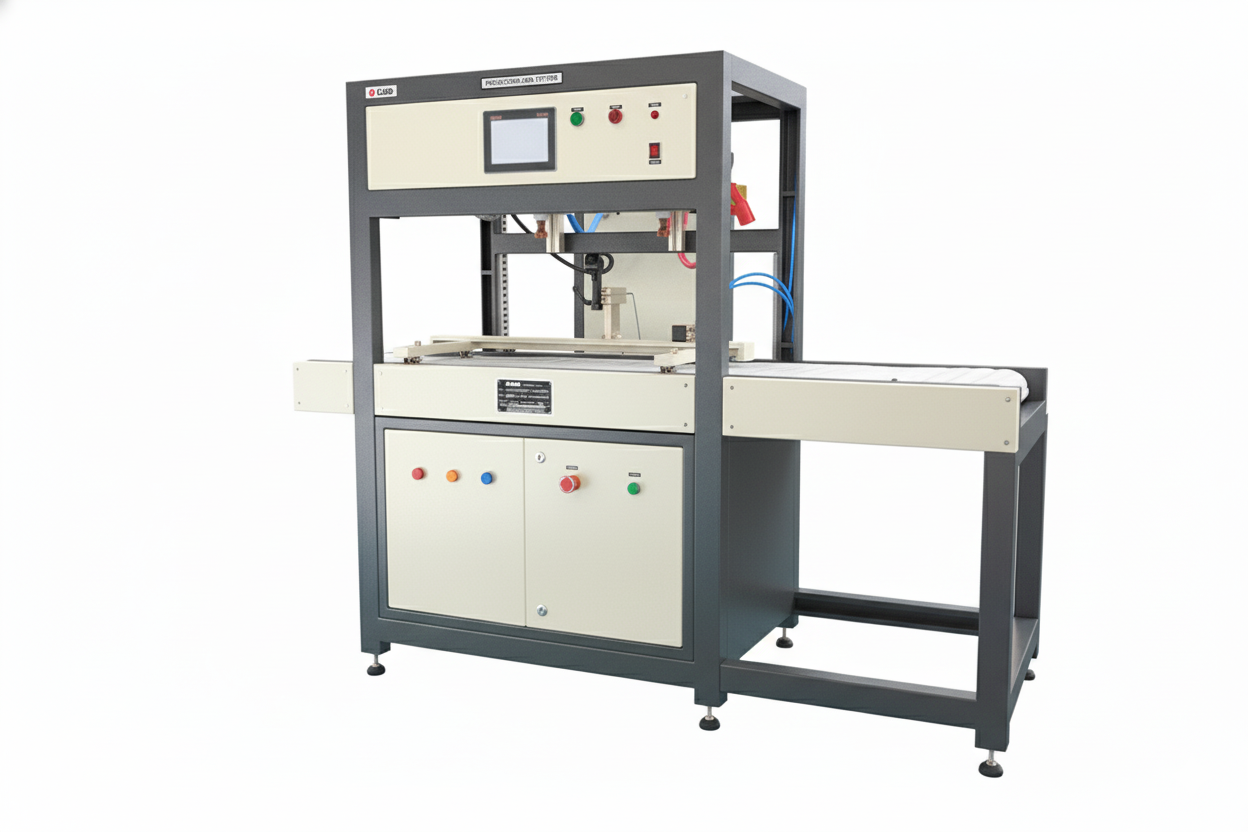
A production line HRD tester is engineered for speed. Test time is 3 to 10 seconds per battery. It sits on or beside the conveyor, tests every unit at line speed, and logs pass/fail against a barcode or batch number. Manual versions suit plants running 100–200 batteries per shift. PLC-controlled, conveyor-integrated versions handle higher volumes with no operator bottleneck.
A lab HRD tester is built for accuracy over extended discharge. Test duration runs 6 to 10 minutes. It is used in R&D for new plate formulation validation, in QC labs for IS 5154 and IEC 60095-1 compliance, and in service centres for cranking capacity (CCA) verification. It is wheel-mounted, portable, and records full discharge curves for analysis.
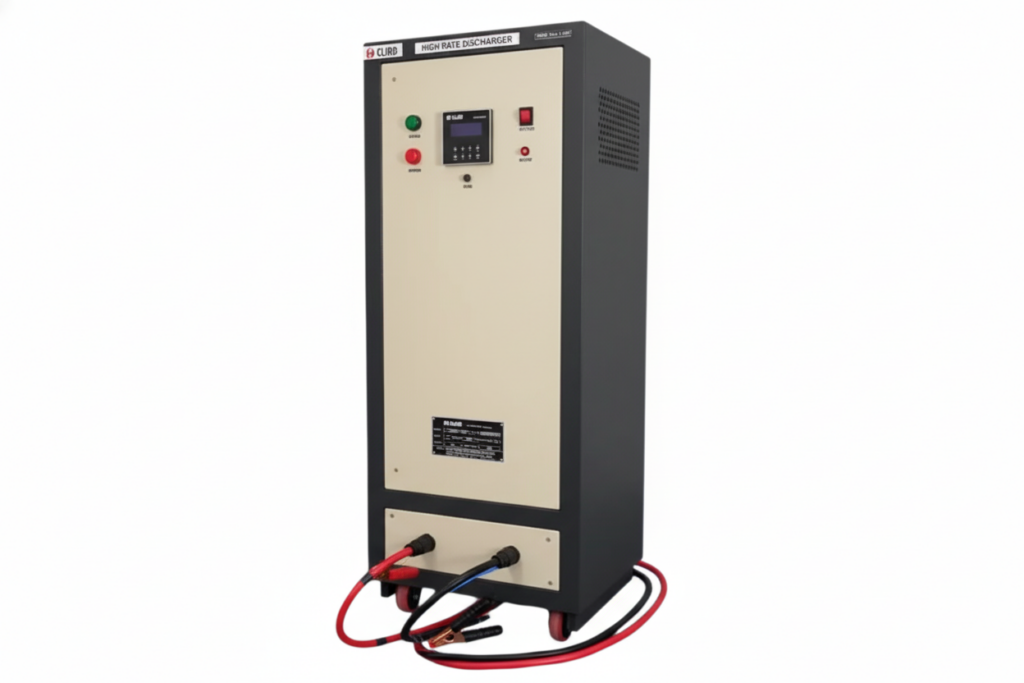
If you manufacture batteries, you need the production line version for 100% end-of-line testing. If you also run a QC lab or supply to OEMs who require IS/IEC test certificates, you need the lab version as well. They are not interchangeable.
What to Demand from a Battery HRD Tester Supplier Before You Buy
Not every HRD tester on the market is built for production environments. Before you evaluate a supplier, ask these questions:
1. What is the test time per battery? For inline production use, you need 3–10 seconds. Anything longer creates a bottleneck.
2. What is the discharge current range? Your tester must match your battery range. SLI batteries need 300–600A. Inverter and tubular batteries may need up to 1000A or higher.
3. Does it log data per unit? Pass/fail alone is not enough. You need discharge current, voltage during test, OCV before test, test duration, and timestamp, linked to a barcode or batch ID. When a customer disputes quality, this record is your defence.
4. Can it integrate with your existing line? Look for Modbus output, PLC compatibility, and conveyor interface adaptability. A standalone instrument that cannot integrate with your production line creates more problems than it solves.
5. What is the controller architecture? PLC-based controllers are more rugged and maintainable than microcontroller-based designs in continuous production environments. They resist calibration drift and are serviceable without vendor dependence.
6. Is the supplier local? When a tester goes down on your production line, a 4–8 week wait for imported spares is not acceptable. A local manufacturer with in-house service support gets you running within days, not weeks.
7. Can they customise to your line layout? Conveyor length, integration with existing PLC, barcode scanner specification: these vary by plant. A configure-to-order supplier is preferable to a catalogue-only vendor.
The Bottom Line
Every battery that leaves your line without an HRD test is a bet – that nothing went wrong in formation, that every weld held, that every cell is uniform. For large manufacturers, that bet ended years ago with inline HRD testing. For mid-size and growing plants, the infrastructure to make that bet unnecessary is available, affordable, and pays for itself within a quarter of warranty savings.
One step you can take today: Pull your last six months of warranty returns. Count the failures that a 10-second high-rate discharge test at end-of-line would have caught. That number is your business case.
ELIND Technologies manufactures battery HRD testers — both production line and lab variants — at our Bengaluru facility. If you are evaluating end-of-line testing for your plant, send us an email or call us / drop us a message on WhatsApp. We will map the right instrument and configuration to your production volume and battery range.