Battery Green Plate Charger: How Indian SLI and VRLA Manufacturers Build Capacity After Formation
Every battery that ships from your plant has been through a charge-discharge cycle that brought it to rated usable capacity and graded it for dispatch. The equipment that runs that cycle sits between the formation line and the QC bench. Most plants discover its limits only when production volume outgrows the channel count they bought. A battery green plate charger sets the throughput ceiling of your dispatch line. Specify it against your 12-month projected output, not your current one.

What a Green Plate Charger Actually Does (And Why It Is Not the Same as a Formation Rectifier)
A battery plate formation rectifier converts raw active paste on plates into electrochemically active material. That process happens in acid jars over 24 to 48 hours, before the plates are assembled into a battery cell. A battery green plate charger operates at a completely different stage in the line.
By the time batteries reach the green plate charger, the plates are formed and the cells are assembled. The charger runs a programmable charge-discharge cycle that brings those assembled batteries to rated usable capacity and grades each cell for dispatch. These are distinct equipment categories at distinct process stages, with different electrical specifications and different decision timelines at the purchase order stage.
Procurement decisions that conflate the two tend to produce one of two outcomes: an underspecified activation stage that becomes the throughput bottleneck, or excess formation capacity that the line does not need.
Why a Growing Number of SLI and VRLA Manufacturers Have Moved to This Route
Four operational drivers explain the shift. Each one is observable on a production floor; none requires a market-share claim to be useful.
First, activation cycle time on a green plate charger is a fraction of the 24 to 48 hour in-jar SLI formation cycle. Dispatch throughput on the same labour improves without adding headcount. Second, acid jar handling is removed from the activation step. At scale, this reduces chemical exposure and cuts the ventilation load on the plant floor.
Third, a mixed SLI and VRLA line can share one charger bank across both chemistries. The operator changes the programmable profile for the chemistry in queue; in-house formation requires separate jar setups per chemistry. Fourth, capex per Ah of monthly dispatch capacity is lower on the green plate route once a plant is shipping above roughly 10,000 batteries per month. At that volume, a 6-channel unit handles 120 batteries per pass on a single 3-phase supply without expanding the formation bank.
These are process observations from plants operating at that scale, not industry statistics.

The Charge-Discharge Cycle Is Where Rated Capacity Gets Built and Verified
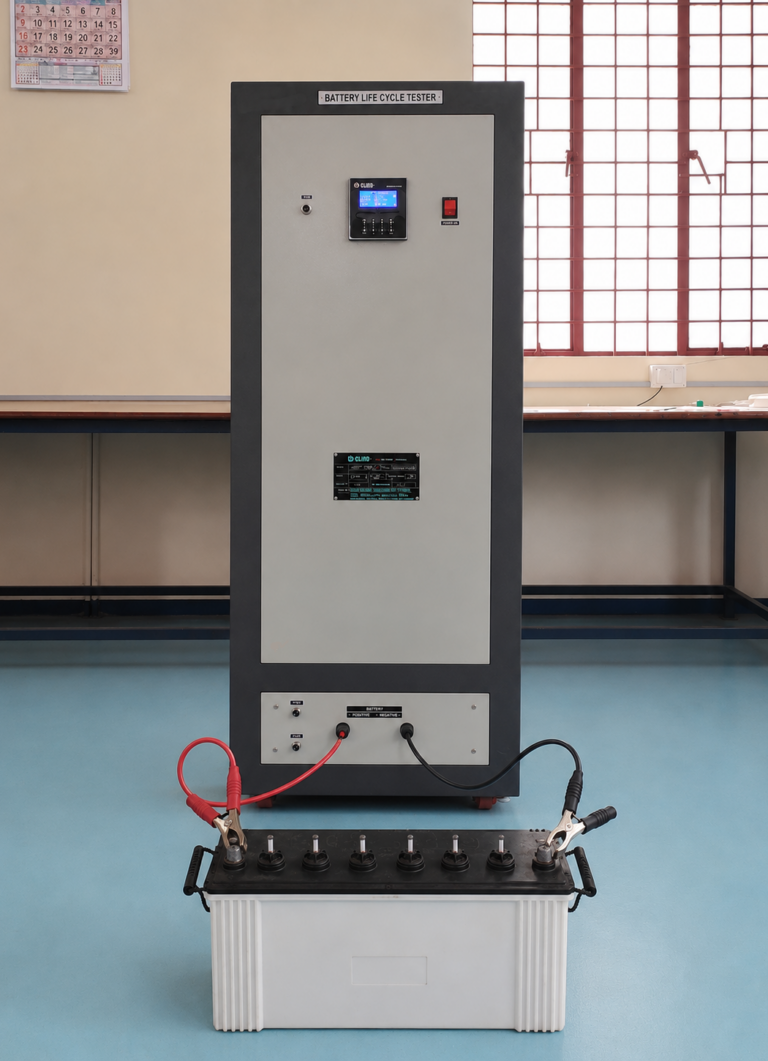
An ELIND battery green plate charger unit cycles 20 batteries per channel in series. Each battery is 12V nominal; the total per-channel bank is 330V DC. The programmable profile runs up to 10 steps, covering charge phases at varied current levels, discharge phases to a set end voltage, and pause steps for thermal recovery between phases.
The discharge end voltage is set at 200V per channel (10V per battery) and is adjustable on the controller. The Ah build-up during the discharge step, again followed by the charge step is what gives the batteries the initial capacity. Batteries reaching 90% of rated Ah capacity proceed to end-of-line testing and dispatch. Those that fall short are held for a second activation pass or pulled for rework.
This is the operational meaning of “builds and verifies usable capacity.” The cycle charges and measures in the same run. The optional data logging add-on records current, voltage, Ah, and elapsed time per step per channel, producing a batch record without manual reconstruction.
Output ripple is held below 5% at full load. This is not a cosmetic specification. A high-ripple discharge waveform introduces error into the Ah count at the shunt, which can grade a marginal battery as passing when the actual capacity is below threshold.
Channel Count Is the Spec That Sets Your Monthly Dispatch Ceiling
A 3-channel battery green plate charger processes 60 batteries per pass. A 6-channel unit processes 120. At two passes per day and 25 working days, the difference is 3,000 batteries per month, with no additional operator and no change to the formation line.
At your ex-factory price per battery, that 3,000-unit gap translates directly to monthly revenue capacity. A 3-to-6-channel upgrade typically recovers the additional capex in 8 to 14 months at 70% utilisation. This is a Director scenario assumption based on typical SLI and VRLA volume ranges; your actual payback period depends on your ex-factory price and utilisation rate.
Most supplier quotations lead with total current output and list channel count in a footnote. Specify channel count as the first parameter, not the last. The current rating tells you how fast each activation pass completes. The channel count tells you how many batteries move through your dispatch activation stage per working day.
6 Specifications to Confirm from Your Battery Green Plate Charger Supplier
Before the purchase order for the battery green plate charger is signed, get these six parameters in writing:
- Per-channel current rating: The 20A to 50A range covers most SLI and VRLA applications. Specify against your average battery capacity, not your peak.
- Discharge end-voltage adjustability: The 200V default (10V per 12V battery) must be adjustable on the controller for mixed chemistry lines or non-standard battery bank configurations.
- Programmable step count: 10-step CC is the practical minimum for SLI and VRLA activation cycles. Fewer steps reduce your ability to tailor profiles for mixed lines or marginal plate batches.
- Output ripple at full load: Below 5% is the ceiling for consistent Ah measurement accuracy in SLI and VRLA applications. Confirm this figure at full load, not at nominal output conditions.
- Data logging: Batch traceability is required at ISO audits and increasingly for export documentation. Confirm whether logging is built-in or a chargeable add-on before the order is placed.
- Transformer cooling specification: For continuous duty at Indian ambient temperatures up to 45°C, oil-cooled is the lower-risk specification. Air-cooled units cost less at purchase. On a continuous activation duty cycle, they reach end-of-life sooner.

A battery green plate charger is not a finishing step in your production line. It is the step that decides which batteries ship and which get pulled. The ceiling it creates is fixed by channel count, not by current rating. Specify it against your 12-month volume target, confirm the six parameters above with any supplier, and build the activation stage for the production line you are scaling into.
Talk to ELIND about your green plate charger requirement
ELIND Technologies has been manufacturing battery charging and testing equipment from Bengaluru since 1980. Every battery green plate charger unit is built to your specification and tested before it leaves our works.
If you are evaluating a battery green plate charger for your production line, send us your channel count requirement, current battery volume, and target throughput by email or call us / drop us a message on WhatsApp. We will send you a technical proposal within 48 hours.